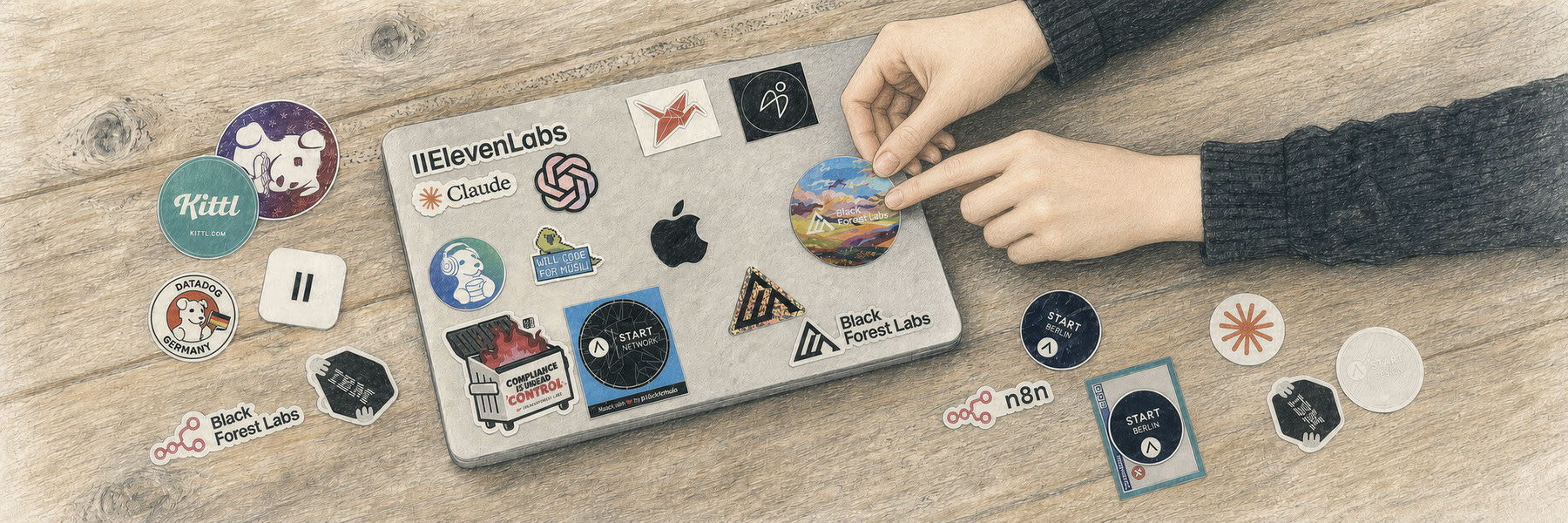
A few months ago, my dad helped me move my tech stickers around until I found the composition I wanted for the back of my laptop. I posted the process on Instagram and called it sticker engineering.
This morning, a friend sent me Vogue's piece about tech companies turning corporate merch into fashion. We had been talking about tech merch the day before, so she knew I would care.
The article looks at what companies are trying to signal through the clothes. I kept thinking about the other side: what these objects come to mean to the people who wear and collect them.
A first-edition tech hoodie might eventually mean more to the right person than a designer sweater. Not because of the fabric, but because it records a company, a product, and a moment people wanted to be close to.
OpenAI's Supply Co. now sells a $175 Research half zip. Palantir has released a chore coat and a limited tennis collection and has even run a merch pop-up in Seoul.
This is different from getting a free T-shirt at a conference and wearing it to bed. The clothes are being designed, photographed, dropped, collected, and resold like fashion.
OpenAI describes its own objects as "material embodiments of company culture." It also jokes that collectible cards, folding chairs, and graphic hoodies became an emerging currency among employees.
The laptop becomes a record
Tech people have always been weirdly serious about stickers. At almost every event I go to, someone is handing them out alongside hoodies or caps.
A laptop slowly turns into a record of the tools you used, the companies you followed, the events you went to, and the tiny internet moments you happened to catch. Some stickers are legible to everyone. Others only register with the people who were already paying attention.
An older Highsnobiety essay describes merch as something you have to know how to read. The object carries more meaning when you know what came before, where it appeared, and why that moment mattered. An online shop can distribute it much further, but the context does not automatically travel with it.
Consumer researchers have names for parts of this: identity signaling, brand communities, and the extended self. The simpler version is that the right object can say both "this is me" and "these are my people." It can also say, "I was there early."
The hoodie has a timestamp
Pokémon cards are the comparison I keep making with friends. People trade them, grade them, put them up for sale, and track entire collections in apps that look surprisingly similar to investment portfolios. The character or artwork might be what pulls you in, but then there is the hunt for a specific card and the feeling of pulling one that other people want too.
Standout recently made Silicon Boosters, trading-card packs featuring tech founders and companies. People filmed themselves opening the packs, tagged the founders and companies they pulled, and offered trades.
Update, July 27: At YC Startup School, “Who did you get?” became an icebreaker. Attendees compared their cards, traded across tables, and asked speakers to sign them.
I keep wondering what else will become collectible. A first-run hoodie, a launch sticker, or something handed out in one room before anyone knew whether the company would matter.
I had that comparison in mind when I wrote about prototyping a collector app for builder artifacts in my June builder update. The example I kept returning to was Google's limited-edition Nano Banana sweatshirt, made for the model launch and initially given to employees who had worked on it. It later appeared in Google's public merch shop. Part merch, part provenance trail. I called the idea a joke and also not a joke.
Technology gives these objects unusually precise timestamps. A model launch, a merger, an early event, or a product name can place something inside a very specific version of the industry. A date can make an object feel scarcer and more meaningful.
I know a few people who own one of Anthropic's "Thinking" caps, which the company gave away at pop-ups. Maybe one of them can still be convinced to give it to me. During New York Tech Week, I also saw people posting from an ElevenLabs pop-up where visitors could haggle with an AI agent for merch while a robot served coffee. In both cases, the way people got the object became part of its provenance.
Scarcity alone is not enough. Limited drops can also frustrate people, and a sold-out sweatshirt is not necessarily one anybody will care about ten years later.
Vogue found current OpenAI tees listed for around $250 on eBay. Listings are not sales, so I would not call this a proven resale market. But someone is already testing whether the object is worth more than the fabric.
I think early pieces tied to companies and product launches that people come to care about will become memorabilia. Their value will come from the story, the date, who could get one, and whether the provenance can still be checked later.
Culture needs characters
I have followed technology companies for years with the intensity other people bring to celebrities. I want to know who is building what, which products just launched, where people are meeting, what is getting funded, and what everyone around the company is making and saying.
Paula Hübner Wehmeyer recently wrote that kids want to become tech entrepreneurs instead of rockstars. She also pointed to venture capitalists and AI builders at the Met Gala, AI artists in galleries, and founders in magazine spreads.
You can see the same shift in media. Silicon Mania turns tech news into entertainment, giving people recurring formats, personalities, and references to follow. Over time, the events, objects, and posts become a shared history people can refer back to. That context makes merch easier to read. Once you know the characters and references, wearing the logo becomes a way of placing yourself inside the story. It can also mean carrying what the company stands for.
Palantir makes the allegiance part unusually explicit. Its head of strategic engagement told GQ that people wear its merch to signal alignment with the company's mission. The company's politics and actions travel with it.
Under a WSJ Magazine post about OpenAI's merch, several commenters said the clothes would help them identify people they wanted to avoid. That is anecdotal, but it shows how the signal can work in reverse.
OpenAI pieces were selling out while Highsnobiety described the collection as visually generic. That is part of what interests me. The clothes can look generic and still sell because the logo carries meaning beyond the design.
People care first
The order matters. The object gives an existing feeling physical form.
If nobody cares about the product, the people, or the moment around it, limited stock only gives you a scarce sweatshirt. OpenAI says Supply Co. began inside the company, where employees were already forming strong opinions about the objects before the public shop arrived.
Companies become part of culture when people want to spend time around them even when they are not actively using the product. They follow the founders, repeat the jokes, travel to the events, and look for other people who care about the same thing.
A 2020 study of participative brand communities found that members take on roles that build, maintain, and support the group. Merch can make that community visible, but it cannot create the feeling on its own.
With Just Move to Europe, I brought the startups, investments, people, and events I was tracking across Europe into one place to make the ecosystem easier to see and enter. I built FandomOS because I noticed that people who care about a company often want to contribute instead of watching from the outside. It was a gamified system where they could complete quests, give structured feedback, and earn rewards from technology companies.
I am as interested in the culture around technology as I am in the products themselves. The stickers give us something physical to keep from a moment that would otherwise live entirely online. Then we put them on our laptops, photograph them, and let the moment travel further.
I wonder which of today's free stickers and hoodies people will search for ten years from now.
Further reading
- Identity and belonging: identity signaling, brand communities, and the extended self.
- Merch as media: Merch Is Media and The Cultural Flywheel.