June made me say the work out loud. July made it much clearer what the work needs next.
I followed several interests far enough to see where they connected. I went deeper into context systems and into the culture around technology, from the objects people keep to the rooms where builders find one another. One of those interests also became a product test.
I still want to build a company. July made me more honest about what will actually move me closer to one. I can build a lot on my own and get encouraging responses online. That is useful, but it does not tell me whether I have found a problem someone actually wants solved. I need to put ideas in front of people sooner, spend more time inside companies, and do more of the work with others.
What I built
I made Where Would You Build?, my first AI short film for Just Move to Europe, during the fal x Sequoia Video Hackathon. It took more than 100 image and video generation requests. I wrote about what survived the edit and what I would change next time in Five Generated Seconds Do Not Make Five Seconds of Film.
Alongside the film, I kept working on JMTE itself. I rebuilt parts of the city experience, event discovery, and resource system, and made it easier for people to suggest events and contribute. More of the routine maintenance can now happen without me checking every source by hand.
I also looked at how people were finding the site. In Vercel, Vienna was the most visited city page, and most traffic arrived through Google. More than half was attributed to the US and most came from devices running GNU/Linux, so I suspect a fair amount came from crawlers. JMTE is also appearing in Google and AI search, which means the SEO work is doing something. What I cannot see yet is how many real people find it and whether it helps them once they arrive.
That matters because I want JMTE to remain useful and free without making it the only thing I work on. It is close to my heart, and I will keep building it. The system now gives me room to do that while I figure out what I want to spend most of my time building.
I also replaced my Superwhisper subscription with whisper.cpp, the large-v3-turbo model, and OpenWhispr. I use voice constantly to get raw thoughts out, so running transcription locally removed a recurring cost.
Context became a question of trust
Mini-Me started as a way to stop re-explaining myself and my projects every time I opened a new agent session. In July, the technical question shifted from how to save more context to how an agent decides what to trust now. I worked on retrieval, skill ownership and routing, behavior verification, and a clearer boundary between the private memory system and Companion, its desktop interaction layer.
The most useful failure happened after four application tests passed. A newer answer existed, but Mini-Me was still choosing the older one as current. I added a regression test and changed how the system decides what should count as current.
One unexpected July find was Milla Jovovich's MemPalace, a local-first system for searchable AI conversations. Yes, the actor from The Fifth Element. I am looking at what Mini-Me can learn from it without letting old conversations override the present.
Tech culture became a product test
The collector prototype already existed in June, and the research behind it had been building for months. Writing Tech People Are Weirdly Serious About Stickers helped me explain why I kept returning to it.
Tech companies release stickers, hoodies, trading cards, launch objects, and employee artifacts, but the information around them is scattered across company shops, social posts, event photos, and resale listings. It is surprisingly difficult to see what exists, tell releases apart, or preserve the story of how a particular object reached its owner.
I started calling the prototype Tech Grails. I do not think this space needs another marketplace first. I am interested in what a trusted archive and personal collection could look like, where people can discover these objects, record what they own or want, and keep the story attached to a particular copy.
I keep returning to fandom too. People who care about a technology company often want to participate instead of only watching from the outside. I am still thinking about better ways for companies and communities to involve those people, and whether that belongs in the same product or somewhere next to it.
I also completed the INSIDE LVMH certificate to learn what luxury companies know about building great consumer products. What stayed with me was how broadly they think about what they are building. The story, the service around it, how it makes someone feel, and whether it can still be repaired years later are all part of the product. I want to think that broadly about the things I build too.
The rooms around the work
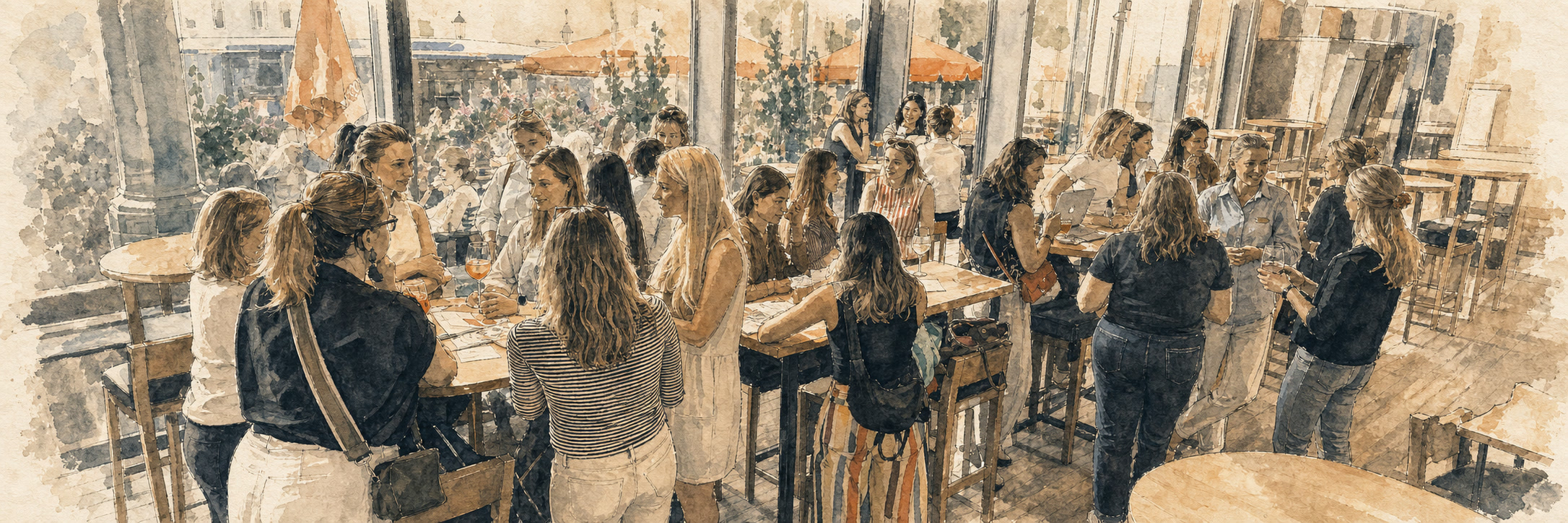
In June, I wrote that I wanted to create more of the rooms I wanted to be in. Around the same time, I met Tina, who had just moved from London and missed the circle of women in AI she had there. Together with Tanja, we decided to host our first Women in AI Social in Munich.
Our first instinct was to find a sponsor and build a program around it. Friends who regularly organize builder meetups and demo nights advised us to keep it simple instead.
So we used a few standing tables, everyone bought their own drinks, and most of the evening stayed open. Registration filled within 24 hours. Around 30 women moved between tables, made room for others to join, and kept talking. Usually there are only a handful of women at the AI events I attend, and whether we actually meet is mostly chance. This time, I had a whole evening to meet women I might otherwise only spot across the room.
After I wrote about it, people kept responding to how simple we had kept it. Several offered to help host future editions, someone proposed bringing it to Berlin, and the post started a wider conversation about why we make tech events so complicated.
I also love that Europe is making more room for people who start building young. Project Europe backs founders aged 25 or younger. Relativity Collective connects students across European universities, and ESRA does the same for student robotics builders. I already feature initiatives like them on JMTE because I want more people to find them.
I just keep thinking about everyone who arrives at the same point a little later. Turning 26 should not mean graduating from hack nights into lanyards and panel discussions. Some people decide they want to build at 27, 31, or 35, after a degree, a first job, or several years inside an industry. They bring real experience and still want builder houses, dinners that turn into work sessions, and new friends with unreasonable ideas.
I want to find the people already creating spaces like these without the age cutoff, support them, and make them easier to discover. Maybe that belongs inside JMTE. Maybe it becomes something separate. I would help build that room.
I took content more seriously
I continued working on my communication skills in July through four MasterClasses on conflict, people intelligence, conversation, and negotiation. Communication sits underneath almost everything I care about, from relationships to work, and I want to become much better at it. Storytelling is part of that too, so my Storyteller Tactics deck from Pip Decks might finally get some proper use.
I also tried a few new formats. I created my first reel and practiced voiceovers. A recording that lasts less than a minute can somehow turn into three hours of catching mistakes, changing the wording, and starting again. One session left me with a headache and a sore throat.
Across the month, I published five essays, 14 posts on X, and six on LinkedIn. The LinkedIn posts received 25,152 impressions and the X posts 16,706, with 162 net new LinkedIn followers and 46 net new X followers. More than half of the 10,067 people I reached on LinkedIn were outside my network. The Women in AI post was the strongest, with around 8,000 impressions and 247 engagements.
The writing also moved the work. The sticker essay brought me back to Tech Grails. The film notes became a better workflow for the next production. Revising How I Work and publishing How I'm Choosing a Cofounder made the people side of the focus question clearer.
Most of these essays live on my website. I am thinking about publishing more of them on Substack, where people can subscribe and reply, to see whether that makes the writing more of a conversation.
The equation became clearer
Looking back at the list I set in June, I followed through on most of it. I had more builder calls, joined cofounder-matching formats, reconnected with mentors, and shared the work more consistently. I did not finish the real-world field content for JMTE, establish a recurring user-feedback loop, or submit more grant and fellowship applications. Those stay on the list.
I eventually wrote the focus question down almost like an equation. I want the work to be valuable, I want to build with people who make me faster and better, and I want more chances for serendipity. I can influence all three by spending more time inside companies, putting ideas in front of people sooner, and doing more of the work with others.
I am genuinely interested in many things, and I like that about myself. I do not need to become interested in fewer things. I need to choose one thing at a time to test properly. The open question is which topic deserves that focus. If I am going to spend years on something, it needs to solve a problem people will pay to have solved and have enough room to grow. Until I find it, each test needs to help me decide whether to double down or move on.
I know I do better work and move faster with the right people. A paid project, a focused sprint, or joining the right early-stage team could all bring me closer to the problem and the people I want to build with.
Two beta tools I tried
I tested an early version of Fredie, built by Lili Vogelsang. It turns years of her research and thinking about friendship, connection, and social skills into personalized exercises. They work a little like Duolingo. I can see it being genuinely useful for people who want to work on their social skills or become more confident around others, which feels like a very good use of technology.
My friend Jordan Legg at Takara also gave me early access to Miru. It combines semantic and lexical search to find the relevant code before sending it to an agent, using up to 50% fewer tokens per search. I have not measured the exact savings myself yet, but it is working well in my projects and I am a big fan. I can also recommend listening to Jordan's episode of The Objection Room. You might get a sense of why I think he is a builder worth betting on.
Also, life
I was lucky enough to find the OL Collective through a LinkedIn post in June. Every Tuesday, Almira Selin Kahya guides a small group of us through exercises around self-awareness and how we want to live. The first chapter focused on authenticity. One exercise had us choose three values and look at how well an ordinary day served them. The useful part was not naming the values. It was seeing whether my actual week reflected them, and how the same work could feel completely different depending on where and with whom I did it.
A friend and I also started a weekly book club. Mind Magic by James R. Doty was our first one. We agree on a section, then meet to compare what we noticed and how it connects to our own lives. Separately, Bill Gurley's Runnin' Down a Dream helped me distinguish between aspirational mentors, practical mentors, and peers, and look more deliberately at the people already around me.
My tomatoes finally grew, so you can now safely endorse my vegetable gardening skill on LinkedIn.
August
For the rest of August, Tech Grails gets one short test. I will put the prototype in front of collectors and companies and see what they actually do with it. If collectors come back to maintain their collections or companies contribute data, it earns another sprint. Otherwise, I will pause it.
For Just Move to Europe, I want to find a better way to measure whether people actually benefit from the links and resources they find there. Did someone discover an event worth attending, a community to join, or information that helped them make a decision?
Mini-Me will keep changing as my work changes and I find new things I need it to do.
By the end of August, I want one concrete commitment that involves someone other than me, whether that is a shared sprint, a customer test, paid work, or joining a team.