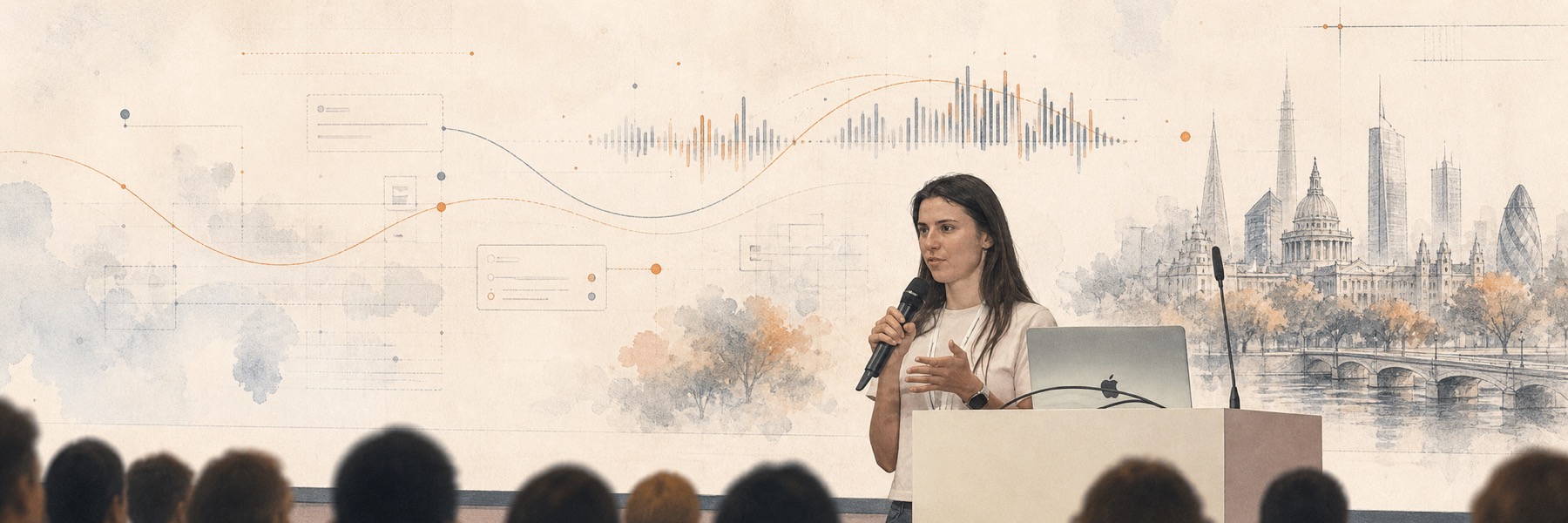
A few weeks ago, I had a hackathon coming up. Just knowing I’d have to present was enough to set off a physical reaction.
I’d thought getting better meant getting rid of that reaction. It turned out I could enjoy being on stage without making it disappear.
For a long time, I hadn’t needed to do much public speaking. At university, I could get through most things without presenting. Then COVID moved those opportunities online, and after that I spent a lot of time building alone. The less I did it, the more charged it became.
I was still social. I could talk for hours at a dinner or founder event when it felt natural. But the second attention became official, a room, a turn, a stage, something flipped. My pulse would climb. My breathing would go shallow. My throat would feel thick. Sometimes I got the strange fear that I wouldn’t be able to swallow. Sometimes I wasn’t even the one speaking. I’d be sitting in the audience, already worried that people might turn around and notice I was nervous.
What confused me was that the reaction had no matching fear in my head. I wasn’t worried about failing or embarrassing myself. I knew nothing bad would happen, but my body still reacted to the room like a threat. I was done letting it run me.
So I started working on it. I read Dale Carnegie's The Quick and Easy Way to Effective Speaking and started Patsy Rodenburg's The Right to Speak. I watched talks about stage fright, breathing, attention, and the loop of being anxious about looking anxious. I treated it like a research sprint: read, test, keep notes. And in a slightly dramatic but honest way, I more or less told the universe I wanted to become someone who could speak in front of people.
What the research suggested
What surprised me first was how many people this affects. There was much more research, therapy advice and practical language for it than I’d expected. Finding language for things I’d felt in my own body made the whole thing feel less private and less mysterious. I read about attention turning inward, the illusion of transparency, and the idea of interpreting physical activation as excitement.
One pattern felt especially familiar. I’d notice my body reacting and start checking it. Was my voice shaking? Could they see it? Did I look as nervous as I felt? The more I checked, the more threatening the sensations seemed.
So I mapped the loop: sensation, checking, threat, more sensation. Seeing it that plainly turned it into a system I could interrupt.
The advice I wanted to test was to notice the signal without inspecting it, then put my attention back on the room. I’d stop trying to prove I was calm and see what happened.
The practical advice gave me a way to prepare. Know the first sentence, the last sentence and a few beats in between, rather than memorising the whole talk. Try breathing out longer than you breathe in. Have recovery lines ready, so a pause gives you a way back.
- "Let me slow this down for a second."
- "The key thing to notice here is..."
- "What I mean is..."
- "Let me come back to the main point."
Putting it to the test
At the same time, the universe took my wish very literally. Within days, opportunities to speak in front of people started lining up. The biggest one was an invite to Anthropic's first Claude Founder House in Berlin. I assumed it would be a small meetup. It turned out to be a real stage with more than 500 people in the room.
A few weeks earlier, that sentence alone would have wrecked me.
This time, I just ran the plan. The fear didn’t disappear completely, but I also didn’t get caught in the same checking spiral. I put my attention on the room and the thing I’d built, treating the activation as excitement, and enjoyed being on stage. I was not calm exactly. More like: I am here, my body is awake, and I can do this.
The bigger surprise came afterward. People said they were impressed by how confident I was on stage and asked about the product. I’d been so aware of my pulse and my throat that it was strange to hear how differently they’d experienced the same talk. The illusion of transparency I’d read about suddenly felt much less abstract. I was nervous, I spoke anyway, and some people read me as confident.
Where the energy went
Berlin showed me that I could speak and enjoy being on stage without having to feel completely calm. What seemed to help was where I put my attention. Focusing on my pulse and whether people could tell kept me caught up in how nervous I felt. Turning towards the room and the point I wanted to make helped me stay with the talk.
Instead of telling myself to calm down, I told myself I was excited. That felt more believable with a racing heart. It sounds too simple, and it mostly worked. I wasn’t fighting the energy as much; I was giving it somewhere to go.
For a demo, I had a simple structure to follow. The problem, why I built it, what it does, how it works, what I learned. The product carries half the room, so I don’t have to be the whole performance.
I had pictured a future version of me who walks onto a stage, enjoys the room, and talks about what she built. Standing in Berlin, I realized I didn’t have to wait years to become her. I might be anxious, and I might still be good.
After Berlin, it didn’t feel like something I’d survived. It felt like something I wanted to do again, and I’ve already done it twice since at demo nights. Every rep is evidence. Not "I felt amazing," just "I did it."
I’ll get nervous again, and my body will still react. But nervousness no longer means I have to step back.